Ecosystem
TRAPPER is split into independent modules that interoperate over HTTP/REST and a shared database. This page describes each module's role and the deployment scenarios the architecture supports. For the day-to-day stack of this module, see Technologies & stack.
Modules
- Trapper Expert — the core web application, providing all essential system functionalities through a Django backend (its UI is the Django Unfold admin — there's no separate Expert-side frontend; that's Trapper Citizen Science below), backed by a PostgreSQL database with the PostGIS extension for spatial data management, and RabbitMQ as a message broker with Celery workers for asynchronous task processing.
- Trapper Citizen Science — an innovative frontend application for TRAPPER, specifically designed for Citizen Science projects.
- Trapper AI — a module responsible for integrating and configuring AI models for object detection and species classification. This includes the Trapper AI Manager web interface and Trapper AI Worker. Workers can utilize GPUs and can be scaled or deployed across multiple machines.
- Trapper Jupyter Hub (not yet released) — a module for sharing JupyterHub and Jupyter notebooks within TRAPPER, enabling users to explore and analyze data using Python or R scientific libraries.
- Trapper Tools — a Python CLI application for creating and uploading camera trap data packages compatible with the TRAPPER system. Recommended for uploading large volumes of data (many GBs). It features an automated pipeline that can convert, package, and upload data in a single command, optionally triggering post-upload collection processing — automatic sequence building and an AI pipeline for object detection and species classification, for both images and videos. See Convert, package & upload with Trapper-Tools.
Deployment blueprints
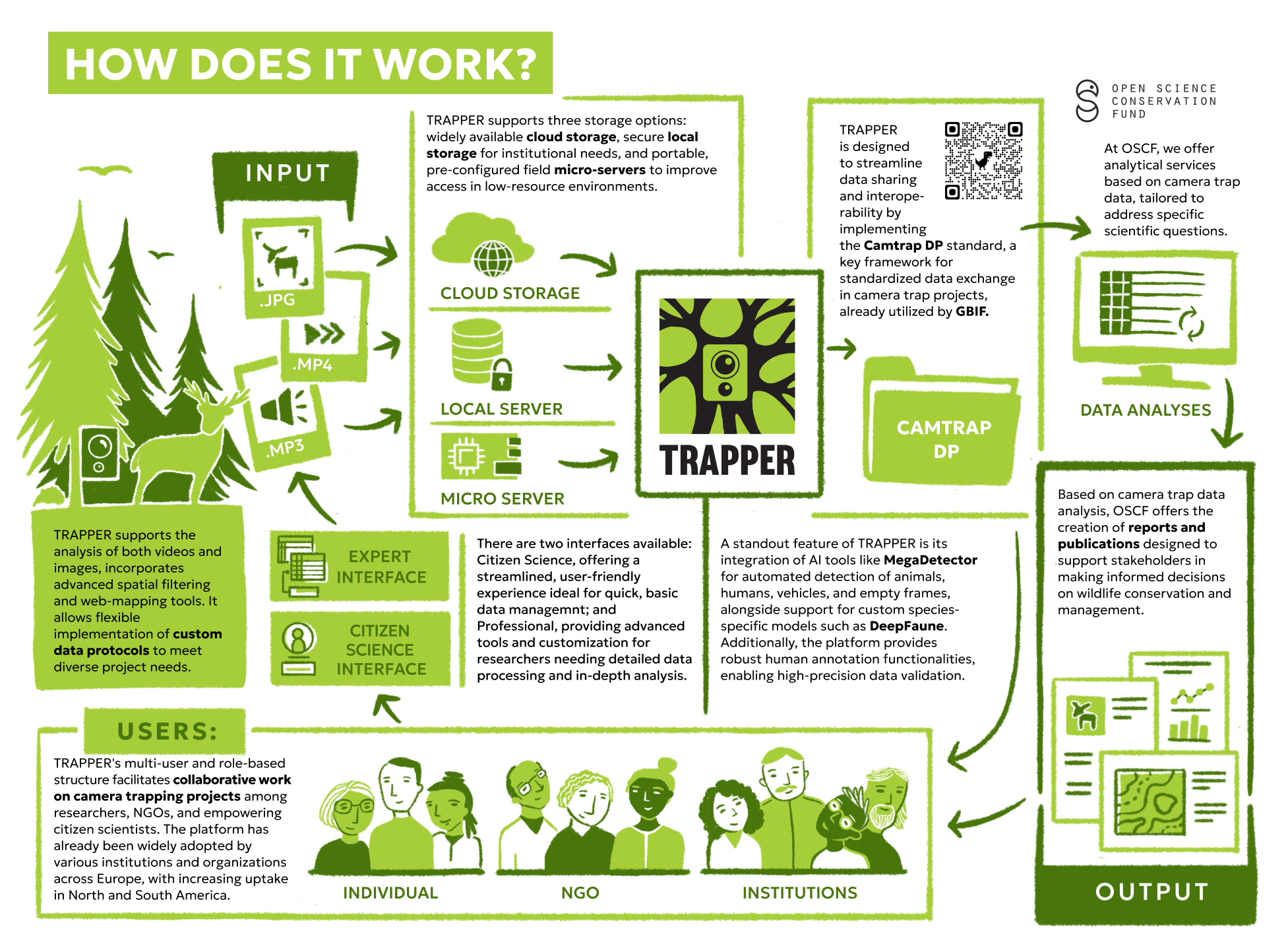
TRAPPER's flexible architecture supports diverse deployment scenarios:
- Laptop/desktop installations for individual researchers
- Lab PC setups for small research teams
- Standalone workstations with GPU acceleration
- Corporate/institutional local network deployments
- Private cloud environments
- Multi-user collaborative platforms
- Microsoft Azure
- Amazon Web Services (AWS)
- OVH Cloud solutions
- MinIO object storage integration
- Raspberry Pi 5 micro-servers for field deployments
- NVIDIA Jetson platforms for edge AI processing
- Portable research stations for remote locations
For the deployment procedure itself, see Deploy with trapper-setup.